

Tech-Tips by Harvey
What Are They?
Modellers are obviously familiar with glues. Given the many types of glues however, navigating the many brands and kinds, and when to use them is the challenge. This “tech tip” article not only covers the different types, but also tips on how to best use them in order to achieve expert results! For this article, I will only focus on” hobby” glues that I use or have used for my plastic models.
These glues all do the same thing – melt (weld) the plastic to join plastic parts. The very first plastic model glues appeared as early as the appeared alongside the first plastic model kits, which started with Frog kits in 1936! These glues became very common by the 1950s/60s as polystyrene kits grew popular. Since then, however, many brands have appeared and here is a list of them as far as I know – many of which are available at Sunward:
For the simplification’s sake, there are two types of model “glues” – 1) glues/solvents; and 2) adhesives.
The terms “glue” and “solvent” are interchangeable and really mean the same thing in this regard. They are chemicals which melt (weld) a material in order to “join” them together. They are different than what I call “adhesives”, in that these glues do not melt the plastic parts together, but rather hardens on its own to “join” the parts together.
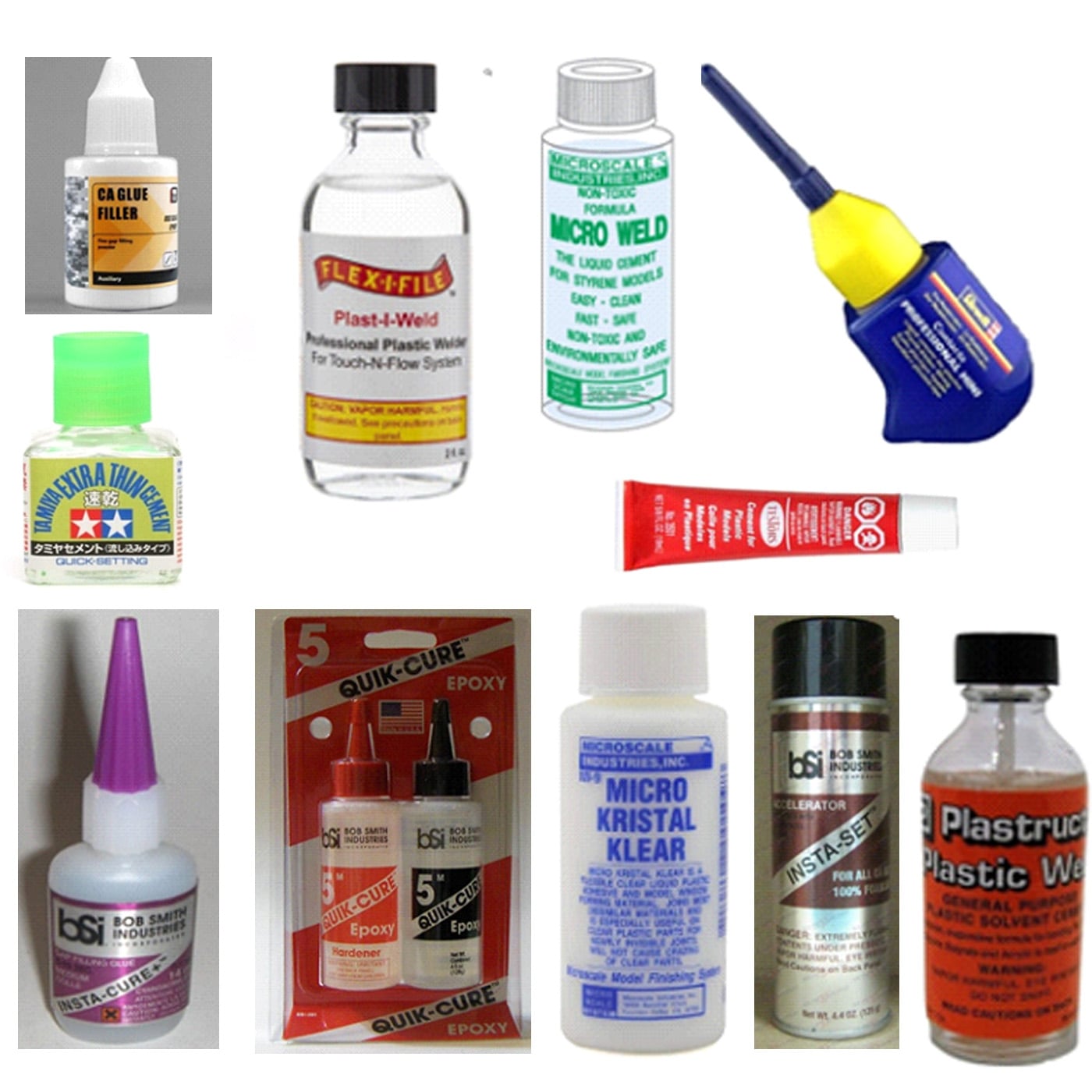
Glues and Solvents
Testors Plastic Model Cement
One of the most common of the styrene “tube” glues made specifically for styrene plastic models (melts then plastic to join them). This glue is excellent for bonding plastic model parts. Just apply this thicker glue (compared to liquid model glue) to both sides in small amounts, then join them together. The first type glue ever made in this hobby so many years ago, that I STILL use regularly to track or position parts for subsequent liquid glue to finish the join. Test the many brands as I find each has its own properties such as some having more “stringly” issues than others.
Humbrol Poly Cement
This is one of my favourite “tube” type glues for models – “poly” meaning “polystyrene”. I find it the best in that it does not have as much “stringy” issues as other tube glues.
Revell Plastic Cement
Another common styrene “liquid” glue made specifically for styrene plastic models. This glue is excellent for bonding plastic model parts. Just position the parts together and apply the thin glue through its built-in needle (although I do find the needle applicator plugs up quite a bit requiring cleaning the tube need with lacquer thinner, which is a bit of an inconvenience). Given the needle plugging issues, I often just uncap the glue and use a toothpick to apply the glue.
Micro Weld
Made by Micro Scale (the same company that makes their famous decal setting solution). It is a liquid glue use specifically to join styrene. In my opinion a bit watery and not what I would typically use, but other modellers may find it useful.
Tamiya Quick-Setting Thin Liquid Glue
Another one of my favourite liquid glues. Tamiya makes their regular (non-thin) which is also very good. It has a white label. It has a built-in brush to apply the glue but I often use a regular think tip brush for better control when applying this liquid glue. Don’t worry about the Japanese labeling as the ones in Canada are the same colour label but in English. AK and Humbrol also make their own brand of liquid glues but I find them essentially the same as Tamiya.
Plast-I-Weld
I use this glue for joining different kinds of “plastics” which more common basic styrene glue may not. It makes permanent bonds on ABS, Styrene, Butyrate, and Acrylic plastics! Not all glues do this! For example, don’t use common Testors and Humbrol plastic Model glues on ABS plastic as they would not be a strong bond. Bonding time is usually between 10-15 seconds. Full cure is approximately 10 minutes, depending on room temperature.
Plastruct Weld
A competitor to Plasti-I-Weld, it also joins different types of “plastics”. It also works well if you want to join different types of plastics such as ABS to Styrene.
Adhesives
WeldBond “White” Glue
Of all the “white glues” I use for scale modelling, this is the one I recommend as it is very strong! It is similar to Elmer’s White glue but much more durable. I use this glue for attaching clear parts such as canopies. I also use it to fill window areas as it dries very clear and strong. It thins with water.
Micro Kristal Klear (White Glue)
Another great glue for attaching canopies and filling small windows on passenger planes or ships. It is however, a white glue that acts the same (just a bit thinner) than other white glues like Elmer’s or WeldBond. Evergreen also makes a similar product called Evergreen Canopy Glue.
Testor’s Clear Parts Cement
This is Testor’s brand of “white glue”. It is also good for gluing canopies and clear parts. It thins with water.
Bob Smith 2-part Epoxy
Of all the 2-part epoxy glues I use for scale modelling, this is the one I recommend from Bob Smith. They make several kinds that vary in curing time, but the 5-minute curing type seems best for me. You mixed equal parts (I use coffee sticks). It is thin enough to work with, while giving time to let it set when a job needs precision positioning. Use this kind of glue to join parts from different materials (e.g., metal to plastic, wood to plastic etc.). This glue is thick and does not thin with any thinner nor is necessary.
Bob Smith Industries Insta-Cure
One of my “go-to” super glues (also called CA glues which technically mean “Cyanoacrylate” glues). This glue is good for its- gap-filling abilities. I prefer this viscosity as thinner super glues tend to run and I prefer this thicker glue. Use it in conjunction with their Insta-Set below.
Bob Smith Industries Insta-Set Accelerator Spray
While technically NOT a glue, I included this product here as a mandatory item in my modelling glue arsenal. It is crucial to have in order to spray it over any “super-glue” to INSTANTLY set it! There are times, for example, that you need the glue to cure quickly, like a delicate part that has very little area of contract such n antenna or radar. It can be used with any super-glue on plastic as well as metal and wood.
CA Glue Filler by VMS
While technically NOT a glue, this product is mixed with CA glue to turn it into fast curing putty you can use for instant gap filling much like the standard putty but without the usual wait times. CA putty dries to solid filling that is easily sanded down. You can also apply this filling in layers and make combined fillings with other putties if necessary.
Recommended to mix with VMS Flexy SLOW CA Glue but can be experimented with other brands of super-glue. Quickly apply the putty and even it with a hobby knife to minimize the residue around the gap. Once the filling is dry sand it with 600 grade paper and follow with finer grades such as 1000 grade.
Final Tips:
1) Always use the glue that it is designed for. For example, do not use white glues to join styrene.
2) Don’t be afraid to use super-glues to fill seams. Their hardening properties make for better seam filling where you do not want those pesky “ghost-seams” that can often remain when using putty for filling seams.
3) Always use in a well-ventilated area (except white glues).
4) I find hardware type Sup-Glues (e.g. Gorilla) a bit too thick or thin, on scale models and prefer hobby brands of CA glues made specifically for scale models.
About the Author:
Harvey Low has been building plastic models since age eight and fast-forward fifty years and he is still building. Now professionally full-time for clients, museums, and magazines. He has written well over thirty articles for mainstream magazines such as FineScale Modeler, and Scale Aircraft Modelling. His specific interests are WW2 Japanese and Italian subjects.
Harvey has been competing in model contests since 1981. He has competed internationally and in 2018 achieved Master Class at the US AMPS national convention. Harvey currently helps run the local Toronto chapters of IPMS and AMPS Fort York Armour modelling club.
 English