

Smooth and Finish Plastic Models
More Flexible than rigid sanding tools. The range covers grits from 180 through 3000.
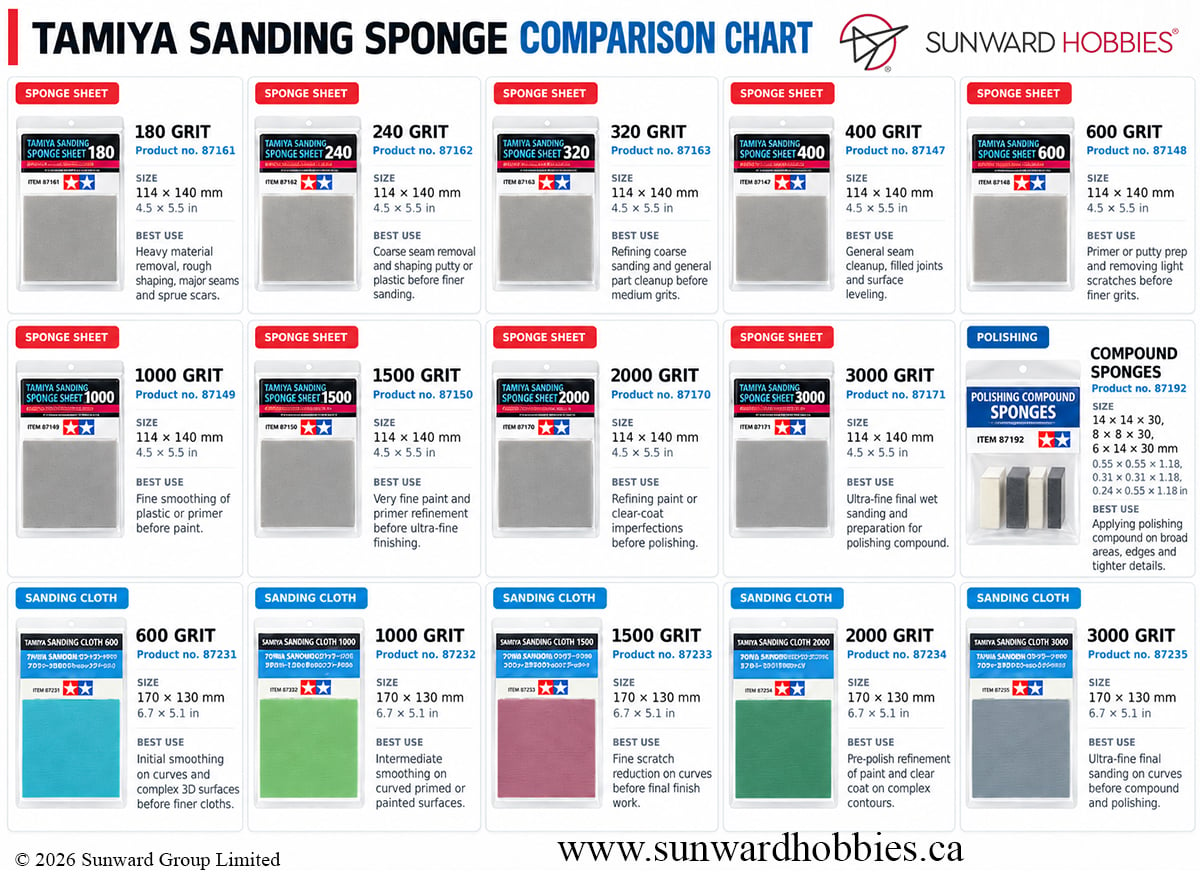
These sanding sponge sheets measure 114 × 140 mm (approximately 4.5 × 5.5 in) and can be cut into smaller pieces as needed. The sanding cloths measure 170 × 130 mm (approximately 6.7 × 5.1 in) and are particularly useful on curved surfaces such as model car bodies.
Both product styles can be used for wet or dry sanding. The comparison chart makes it easier to identify the appropriate grit, product number, size, and recommended use for each stage of a modelling project.
Frequently Asked Questions
What Tamiya sanding grit should I use for removing material or heavy seam lines?
Lower grits remove material more aggressively. The 180, 240, and 320 grit sanding sponge sheets are useful for initial shaping, removing prominent seams, and cleaning up rough areas before moving to finer grits.
What grit is best for preparing a model before painting?
The 400 to 1000 grit range is useful for general surface cleanup and smoothing primer, putty, or plastic before paint. Progressively moving through the grits helps reduce scratches left by coarser sanding.
What should I use for very fine finishing or polishing preparation?
The 1500, 2000, and 3000 grit products are designed for increasingly fine surface refinement. The 3000-grit sponge is especially useful for ultra-fine wet sanding before polishing.
What is the difference between Tamiya sanding sponges and sanding cloths?
Sanding sponges have a flexible sponge backing, while the softer sanding cloths are particularly well suited to curved and complex surfaces. Tamiya sanding cloths are available from 600 to 3000 grit and can be used wet or dry.
Tamiya Sanding Products:
- Tamiya Sanding Sponge Sheet 180 Grit 87161
- Tamiya Sanding Sponge Sheet 240 Grit 87162
- Tamiya Sanding Sponge Sheet 320 Grit 87163
- Tamiya Sanding Sponge Sheet 400 Grit 87147
- Tamiya Sanding Sponge Sheet 600 Grit 87148
- Tamiya Sanding Sponge Sheet 1000 Grit 87149
- Tamiya Sanding Sponge Sheet 1500 Grit 87150
- Tamiya Sanding Sponge Sheet 2000 Grit 87170
- Tamiya Sanding Sponge Sheet 3000 Grit 87171
- Tamiya Sanding Cloth 600 Grit 87231
- Tamiya Sanding Cloth 1000 Grit 87232
- Tamiya Sanding Cloth 1500 Grit 87233
- Tamiya Sanding Cloth 2000 Grit 87234
- Tamiya Sanding Cloth 3000 Grit 87235
- Tamiya Polishing Compound Sponges 87192