

Achieving a smooth and professional-looking finish
Get that finish for your scale models starts with choosing the right polishing compound. Tamiya offers three polishing compound grades:
Each of these polishing compounds are designed for a different stage of surface preparation and polishing.
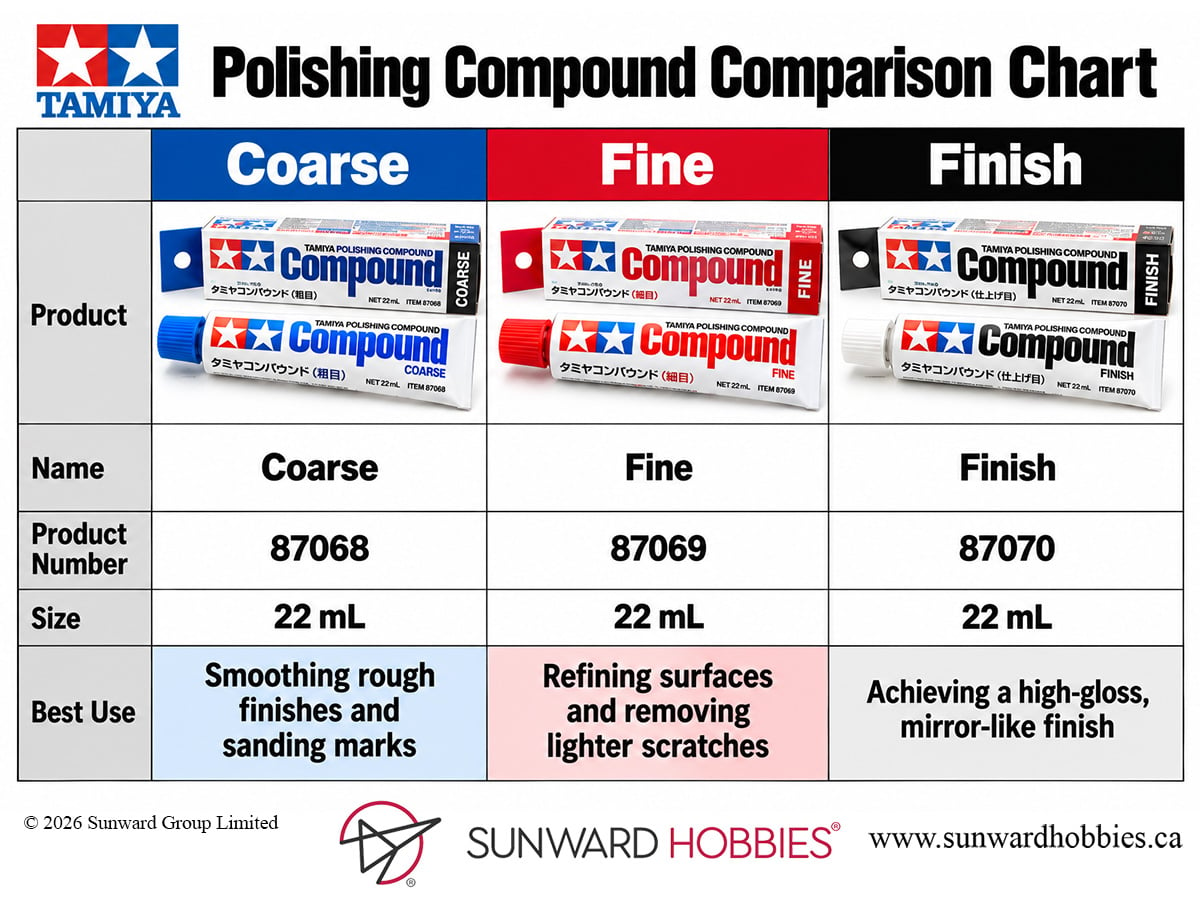
Our Tamiya Polishing Compound Comparison Chart makes it easy to understand the differences between these products and determine which one is best suited for your project.
Coarse (87068) is ideal for smoothing rough paint finishes and reducing sanding marks. Fine (87069) helps refine surfaces, remove lighter scratches, and prepare painted or clear parts for the final polishing stage. Finish (87070) uses extremely fine polishing particles to eliminate minor imperfections and achieve a brilliant, mirror-like shine.
Whether you’re working on model cars, aircraft, or other plastic model kits, selecting the appropriate compound can improve your results. Follow the recommended progression from Coarse to Fine to Finish when needed, using a separate polishing cloth for each grade.
Frequently Asked Questions
What is the difference between Tamiya Coarse, Fine, and Finish polishing compounds?
Coarse removes more noticeable surface imperfections, Fine smooths lighter scratches, and Finish provides the final high-gloss polish.
Do I need to use all three Tamiya polishing compounds?
Not necessarily. If your model already has a smooth surface, you may only need Fine or Finish. Start with the least abrasive compound necessary.
Can Tamiya polishing compounds be used on clear plastic parts?
Yes. Fine and Finish can help reduce light scratches and restore clarity to clear plastic parts such as aircraft canopies. Always test on a small area first.
What order should I use Tamiya polishing compounds?
The recommended sequence is Coarse → Fine → Finish, progressing from surface correction to final polishing for a glossy result.