

Four Formulas and Their Differences
Bob Smith Industries builds its hobby epoxy range around four formulas, each sold in two or three sizes — eleven products in total. They all mix one-to-one by volume and cure by chemical reaction rather than by evaporation, so choosing between them comes down to two questions: how long you need to work the mixed adhesive before it sets, and what the finished joint has to survive.
Quik-Cure is the fast option at five minutes. It cures to a slightly flexible consistency, and that lack of brittleness lets it hold in joints subject to high vibration or stress, though it shouldn’t be used where it will sit in water long-term. It is also the only BSI epoxy you can apply polyester resin over. Mid-Cure gives fifteen minutes of working time, stays the most flexible of the four and bonds well to fiberglass. Slow-Cure is the strongest and fully waterproof, with thirty minutes of working time for structural joints and reinforcing fillets. Finish-Cure is a laminating resin rather than a glue — low odour, easy to sand, made for fiberglass cloth over wood.
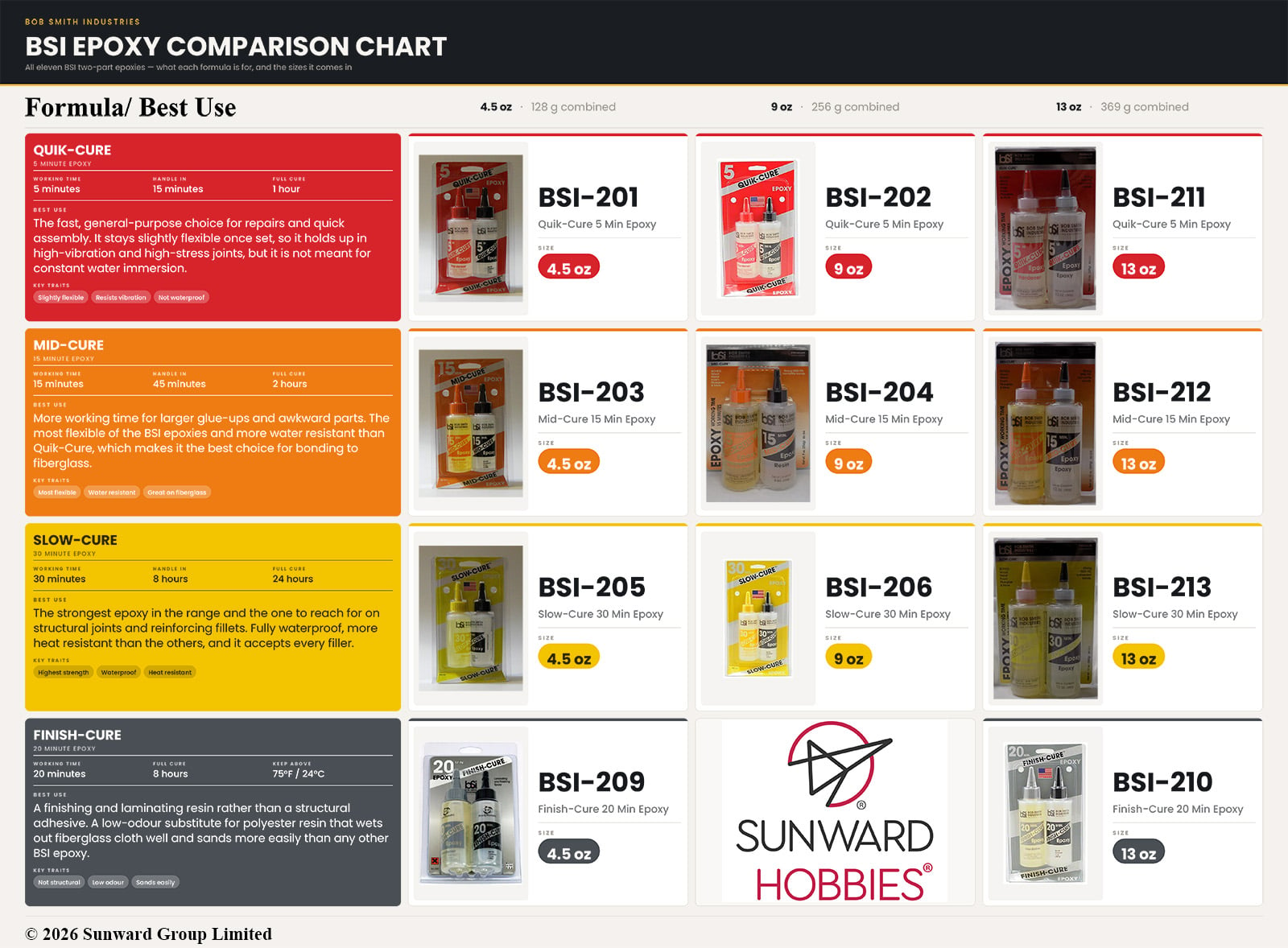
The chart below sets all eleven side by side by formula and size, with working time, handling time, full cure and recommended use.
Frequently Asked Questions
Which BSI epoxy is strongest for a structural joint?
Slow-Cure 30 Minute. The chart lists it as the highest-strength formula in the range, fully waterproof and heat resistant, and it accepts every filler — which makes it the one to reach for on load-bearing joints and reinforcing fillets.
Which one should I use where the joint will vibrate?
Quik-Cure 5 Minute. It is the only formula on the chart marked “slightly flexible,” and that flexibility is what keeps a vibrating joint from cracking. The trade-off is in the chart too: it is not waterproof.
I’m laying fiberglass cloth over a wood surface. Which epoxy?
Finish-Cure 20 Minute. The chart flags it as “not structural” — it is a finishing and laminating resin, a low-odour substitute for polyester resin that sands more easily than the others. Use Slow-Cure for the joints and Finish-Cure for the skin.
Why does the chart show no 9 oz Finish-Cure?
Because BSI doesn’t make one. Finish-Cure comes in 4.5 oz and 13 oz only, which is why that cell in the 9 oz column is marked rather than filled.
BSI Epoxy – Tips & Usage Guide – https://www.sunwardhobbies.ca/epoxy-tips-and-advice/