

American Engine Colours: Why “Just Paint It Orange” Is Usually the Wrong Answer
Few details can undermine an otherwise excellent engine bay as quickly as the wrong engine colour. Get it right and the powerplant immediately begins to belong in the car. Before the viewer notices the carburettor, ignition wiring or casting detail, the colour has already established a manufacturer, a period and often a specific engine family. Get it wrong and something feels off, even when the rest of the build is beautifully executed.
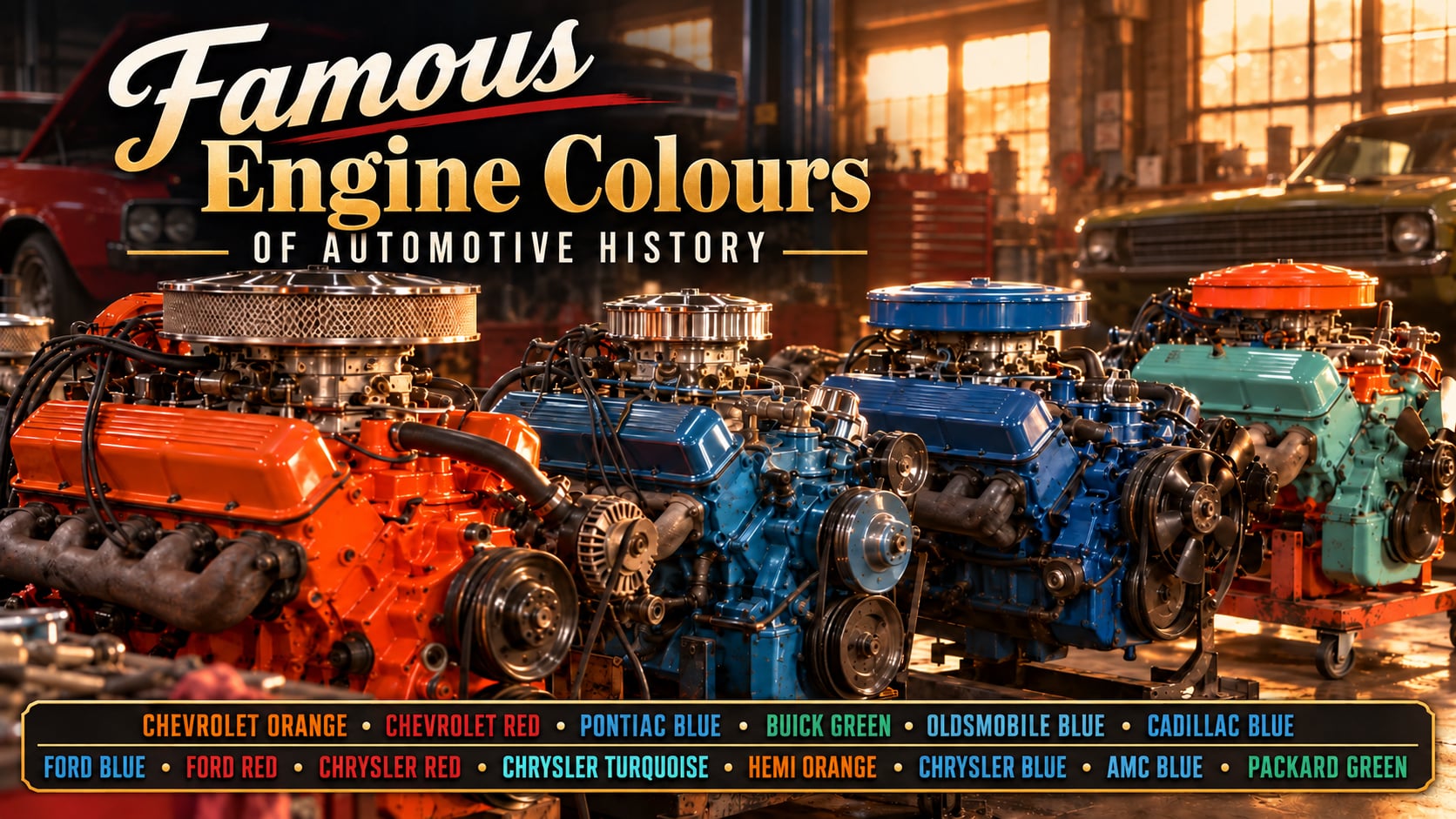
The difficulty is that American engine colour is far more complicated than the familiar shorthand suggests. Chevrolet is orange, Pontiac is blue, Ford is blue and Mopar is Hemi Orange are useful associations, but they are not universal rules. During the 1950s, 1960s and 1970s, engine paint could distinguish divisions, separate engine families, identify a performance specification or simply reflect a factory running change. The useful question is therefore not what colour a manufacturer painted its engines, but what colour a particular engine received in a particular application at a particular time.
Start with the engine, not the badge
General Motors demonstrates the problem better than almost any other manufacturer. A Chevrolet 350, Pontiac 350, Buick 350 and Oldsmobile 350 may share a displacement figure, but they are not the same corporate engine wearing different badges. For much of the classic post-war period they belonged to separate divisional engine families, and they could leave the factory in entirely different colours. The same logic applies elsewhere: a Canadian Pontiac may contain a Chevrolet-derived drivetrain, a pre-1966 Ford should not automatically be treated like a later Corporate Blue Ford, and a Mopar big-block may be turquoise or Hemi Orange depending on specification.
A useful research order is country → model year → division → engine family → specification → build date. Country becomes particularly important with Canadian production, where familiar nameplates were often combined with mechanical components from another division or marque. Model year narrows the period, but it does not always provide a hard boundary because existing paint stocks and running changes could overlap. Division matters enormously with General Motors, and engine family matters more than displacement alone. When a model represents a specific documented car near a changeover, engine codes, paperwork, assembly dates and surviving original paint can settle questions that a general colour chart cannot.
Kits used in this series
These four kits give the series recognizable Chevrolet, Pontiac, Ford and Chrysler Corporation engines. The box art and kit names link directly to the current Sunward product pages.
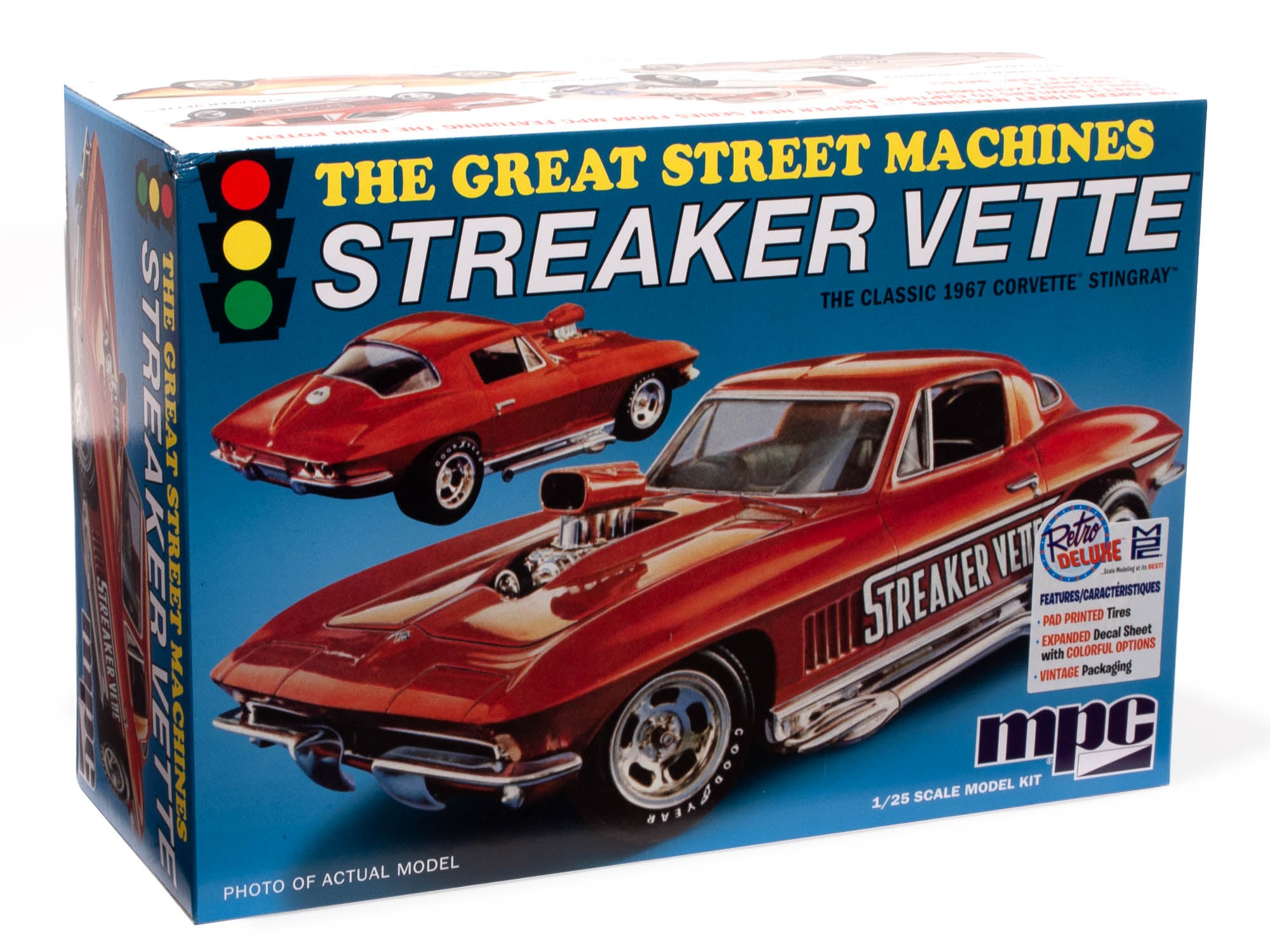
MPC 1967 Chevrolet Corvette Stingray
327 Chevrolet V8. A useful small-block Chevrolet subject for the orange and red engine-colour discussion.

MPC 1967 Pontiac GTO
400 Pontiac V8. The 1967 GTO gives us a clean example of why “Pontiac Blue” needs a year attached to it.
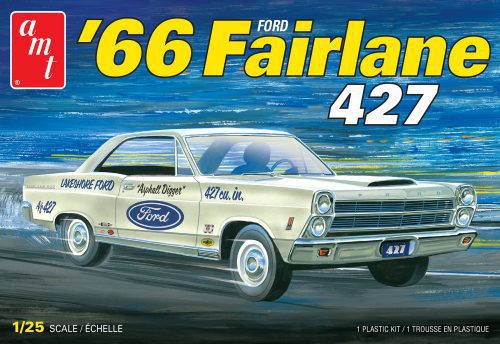
AMT 1966 Ford Fairlane 427
427 Ford V8. A useful Ford subject at the point where the familiar Corporate Blue shorthand needs some context.

AMT 1971 Plymouth Duster 340
340 Chrysler V8. A good counterpoint to the idea that every Mopar engine should simply be painted Hemi Orange.

The badge can still fool you
AMT’s 1936 Ford Coupe Gasser can be built with either a Ford Flathead V8 or a Pontiac 389. It is not a factory-colour reference for a production Ford; it is simply a particularly useful modelling example of why the name on the body does not always tell you which engine you are painting.
Restored cars can mislead you
Modern reference photography has made engine research dramatically easier, but a beautifully restored car can look authoritative while reflecting decisions made decades after it left the assembly line. Restoration finishes may be glossier than factory paint, components may be individually masked that were originally sprayed together, and fasteners may be left natural or plated even though they were painted in production. Exhaust manifolds are often refinished in durable cast-grey coatings that represent fresh iron rather than the appearance of a heat-cycled factory engine. Restored vehicles remain useful references, but factory publications, judging manuals, unrestored examples, original paint remnants and vehicle-specific documentation deserve more weight when the references disagree.
A colour name is not always enough
Pontiac Blue is a good example. There was not one single Pontiac Blue used unchanged for decades; the hue shifted, metallic content changed and later engines adopted different formulations while enthusiasts continued using the same broad descriptive name. The same problem applies to Ford Blue, AMC Blue and even Chevrolet Orange. For modelling purposes, the year belongs in the colour description. Thinking in terms of 1967 Pontiac Blue rather than simply Pontiac Blue makes it much easier to compare the correct photographs, surviving finishes and hobby paints.
Recreating the familiar engine colours
For years, car modellers could buy many of the familiar American engine colours straight from the bottle. Testors Model Master carried names that became part of the hobby vocabulary: Ford Engine Blue, Pontiac Engine Blue, Olds Engine Blue, Chrysler Engine Blue, Chevrolet Engine Red, Chrysler Engine Red and others. Once that range disappeared, old stock became something to find rather than something a modeller or retailer could depend on for a new build.
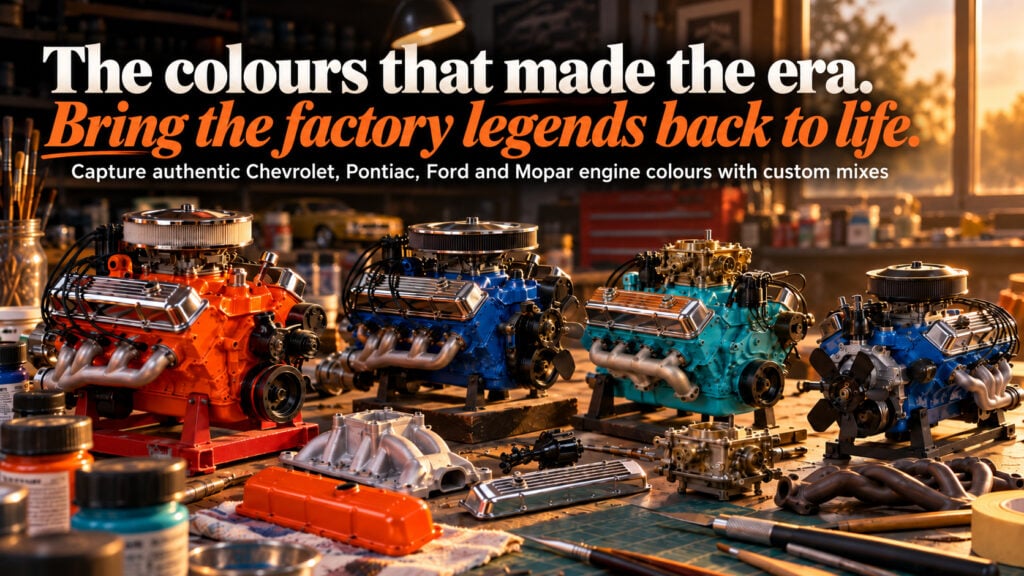
Custom mixing gives us a more useful way forward because the object is not simply to replace one discontinued bottle with another bottle carrying the same broad name. The historic targets include Chevrolet Engine Orange, Chevrolet Engine Red, Pontiac Engine Blue, Buick greens and blues, Oldsmobile Engine Blue, Cadillac Blue, Ford Engine Red, Ford Engine Blue and Corporate Blue, Chrysler Engine Red, Chrysler Turquoise, Hemi Orange, Chrysler Engine Blue, AMC Engine Blue and Packard Green. Some of those names cover more than one period shade, which is precisely why the manufacturer articles will tie the colour to the year and engine before giving the formula.
The four working paint systems below provide the ingredients for those colours. They are not the recipes. Part 2 begins with General Motors and supplies the proportions only after the Chevrolet, Pontiac, Buick, Oldsmobile or Cadillac engine has been identified. Tamiya X/XF and Tamiya LP are treated separately because they are different paint chemistries. The same approach then carries through Ford, Chrysler Corporation and the independent manufacturers.
Paints used to build the colours
Each linked colour is part of the working palette. The mixes themselves follow in Part 2.
AK Real Colors
Flat Black RAL 9005 RC804
lacquer
Flat White RAL 9003 RC806
lacquer
Red RAL 3000 RC810
lacquer
Orange RAL 2004 RC812
lacquer
Yellow RAL 1003 RC814
lacquer
Pale Blue RC816
lacquer
Blue RAL 5001 RC817
lacquer
Pure Blue RAL 5005 RC818
lacquer
Aluminium RC820
lacquer
Forest Green FS 34079 RC900
lacquer
AK 3rd Generation
White AK11001
acrylic
Black AK11029
acrylic
Deep Yellow AK11045
acrylic
Deep Orange AK11080
acrylic
Scarlet Red AK11087
acrylic
Blue Green AK11169
acrylic
Deep Blue AK11182
acrylic
Old Gold AK11192
acrylic
Aluminium AK11207
acrylic
Tamiya X/XF
Tamiya X/XF is the acrylic route used in this series. Its formulas remain separate from the LP lacquer recipes.
Black X-1
81501
White X-2
81502
Blue X-4
81504
Green X-5
81505
Orange X-6
81506
Red X-7
81507
Lemon Yellow X-8
81508
Gold Leaf X-12
81512
Flat Aluminum XF-16
81716
Tamiya LP Lacquer
Tamiya LP is treated as a separate lacquer system. The LP formulas in Part 2 will be developed independently rather than presented as interchangeable with the X/XF acrylic mixes.
The block colour is only half the job
Even a correctly selected colour can produce an unconvincing engine if the factory painting process is ignored. Engines were assemblies, and depending on manufacturer and period, timing covers, water pumps, oil pans, fasteners and other pieces could already be installed when paint was applied. Bolt heads may therefore be painted, gasket edges may carry colour, coverage may be lighter in recesses and a natural-metal bellhousing or adjacent component may show incidental overspray. A carefully restored full-size engine and an untouched assembly-line engine can be two very different references.
Heat starts rewriting the finish immediately
Exhaust manifolds make this especially clear. A fresh manifold begins as cast iron and, depending on production practice, may carry some engine-colour overspray. Once the engine runs, paint nearest the ports scorches and recedes, the iron darkens, heat staining develops and oxidation follows. Rust is only the later part of the progression. A useful sequence is cast iron → scorched paint → dark heat staining → oxidation → rust, and how far along that sequence the model should go depends on the age and use of the car being represented.
Surface character matters as much as colour
Scale models are particularly sensitive to sheen. The correct hue buried under a deep wet gloss can look less convincing than a slightly imperfect colour with the right surface character. Cast engine components are rough, stamped steel is smoother, aluminium reflects light differently and machined surfaces do not look like painted iron. Weathering should follow the same mechanical logic: oil belongs around seals, breathers and gasket joints, dust gathers where oil gives it something to stick to, heat affects the exhaust side most aggressively and handling marks occur where mechanics actually reach.
Part 2: General Motors – Coming Soon
Part 2 moves into the General Motors divisions and starts turning the working palettes into actual engine-colour formulas. Chevrolet, Pontiac, Buick, Oldsmobile and Cadillac will be treated separately, with the year and engine family established before the colour is mixed. Each historical target will have routes for AK Real Colors, AK 3rd Generation and Tamiya, along with the application notes needed to make the colour look right on the engine rather than merely right in the bottle.
Engine-bay accessory colours and metallic finishes
The engine colour only covers part of the job. Hoses, ignition wires, brackets, alternators, intake parts, exhaust components and plated pieces all need their own finishes. This block is designed to be reused at the end of the engine-colour articles so the supporting paints stay in one consistent place.
AK 3rd Generation is the brush-work line here, particularly useful for hoses, wiring, clamps, caps and other small details. AK Real Colors covers larger sprayed accessory areas, while Xtreme Metal and Mr. Color Super Metallic II provide the natural-metal and heat-affected finishes. Alclad II Chrome is reserved for the highly reflective plated parts.
AK 3rd Generation — brush details
For small parts where a brush is quicker and more controllable than masking and airbrushing.
Tracks & Wheels 3G Paint Set — AK11672
Includes Black and Rubber Black for hoses, belts and worn rubber.
Scarlet Red — AK11087
Ignition wires, caps and small red details.
Deep Yellow — AK11045
Ignition wires and small colour-coded details.
Deep Sky Blue — AK11176
Blue ignition wires and small painted accessories.
Aluminium — AK11207
Brush-painted brackets, fittings and small aluminium parts.
Gun Metal — AK11212
Dark hardware, clamps and small steel details.
AK Real Colors — sprayed accessories
For larger accessory parts and support colours that are easier to spray with the rest of the engine assembly.
Flat Black RAL 9005 — RC804
Sprayed pulleys, brackets and larger black engine-bay parts.
Aluminium — RC820
Sprayed aluminium accessories and larger metal surfaces.
A-14 Interior Steel Grey — RC979
Useful dark steel-grey support tone for sprayed hardware and cast-metal areas.
AK Xtreme Metal
For alternators, intake parts, natural metal and the first stages of exhaust heat.
Aluminium — AKI 479
Alternators, intake parts and clean natural aluminium.
Polished Aluminium — AKI 481
Brighter polished accessories and machined aluminium.
Steel — AKI 476
Steel hardware and darker metallic components.
Burnt Metal — AKI 484
Heat-affected headers, manifolds and exhaust components.
Mr. Color Super Metallic II
For fine-grained metallic finishes ranging from iron and stainless steel to bright polished metal.
Super Fine Silver 2 — SM201
Fine bright metallic finish for clean accessory metal.
Super Iron 2 — SM203
Iron and darker ferrous parts.
Super Stainless Steel 2 — SM204
Stainless exhaust and polished steel details.
Super Titanium 2 — SM205
Subtle warm metallic variation for exhaust and hardware.
Super Chrome Silver 2 — SM206
Bright plated-looking parts where full mirror chrome is not required.
Alclad II Chrome
For the parts that should read as chrome rather than ordinary silver paint.
Chrome for Plastic — ALC-107
Mirror-bright chrome for plated valve covers, air cleaners and bright engine dress-up parts.
Thinners, flow additives and airbrush cleaners
Keeping the thinner beside the paint system avoids one of the easiest mistakes at the bench. The products below are grouped by the paint systems used in this series; where a thinner works across more than one line, those compatible paints are listed beside it.
Thinners and flow control
| Thinner / additive | Compatible paints in this series |
|---|---|
| AK Real Colors High Compatibility Thinner — RC701 | AK Real Colors; Tamiya X/XF |
| Tamiya Lacquer Thinner — Yellow Cap 87077 | Tamiya LP; Tamiya X/XF; AK Real Colors |
| Tamiya Lacquer Thinner Retarder Type — Orange Cap 87194 | Tamiya LP; Tamiya X/XF; AK Real Colors |
| Tamiya X-20A Acrylic Thinner — White Cap 81520 | Tamiya X/XF only |
| Mr. Color Leveling Thinner — T108 | Mr. Color Super Metallic II; AK Real Colors; Tamiya X/XF |
| Mr. Color Thinner — T104 | Mr. Color Super Metallic II; AK Real Colors; Tamiya X/XF |
| AK 3rd Generation Acrylic Thinner — AK11500 | AK 3rd Generation; Tamiya X/XF for brush work |
| AK 3rd Generation Airbrush Flow Improver — AK11510 | AK 3rd Generation — flow additive, not a thinner |
| AK Xtreme Cleaner & Thinner — AK470 | AK Xtreme Metal — dedicated thinner/cleaner |
Airbrush cleaners
| Cleaner | Paint systems |
|---|---|
| Tamiya Airbrush Cleaner — 87089 | Tamiya X/XF; Tamiya LP; AK Real Colors |
| AK 3rd Generation Perfect Cleaner / All-Purpose Cleaner — AK11505 | AK 3rd Generation |
Keep the chemistry straight: X-20A White Cap is used here for Tamiya X/XF only. AK 3G Flow Improver is an additive rather than a substitute for thinner, and airbrush cleaner should not be used as paint thinner. Alclad II Chrome is supplied ready to spray, so it does not need to be reduced as part of the colour recipe.